Opaque token strings
A JWT can hide useful Header and Payload details behind three Base64URL segments. JWT Decoder makes those parts readable.
أداة مطورين مجانية
الصق رمز JWT وافحص Header وPayload وSignature وexp وiat وiss وsub محليًا في المتصفح. مفكك JWT لا يرفع الرموز ولا يكسر التواقيع.
JWTs are compact and URL-safe, but they are hard to read when login, OAuth, or API behavior breaks.
A JWT can hide useful Header and Payload details behind three Base64URL segments. JWT Decoder makes those parts readable.
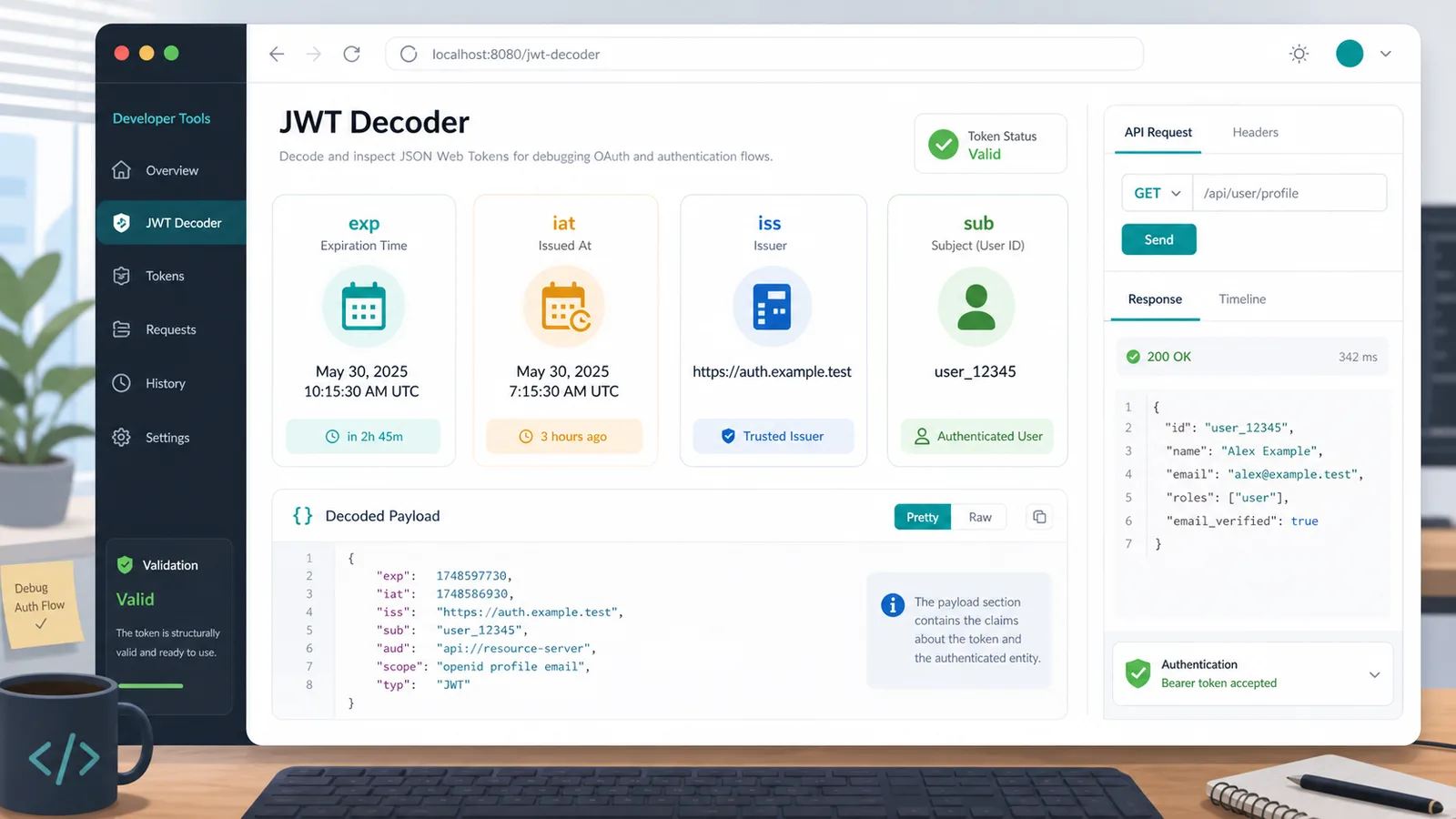
exp and iat are NumericDate values in seconds, so JWT Decoder converts them into human-readable dates.
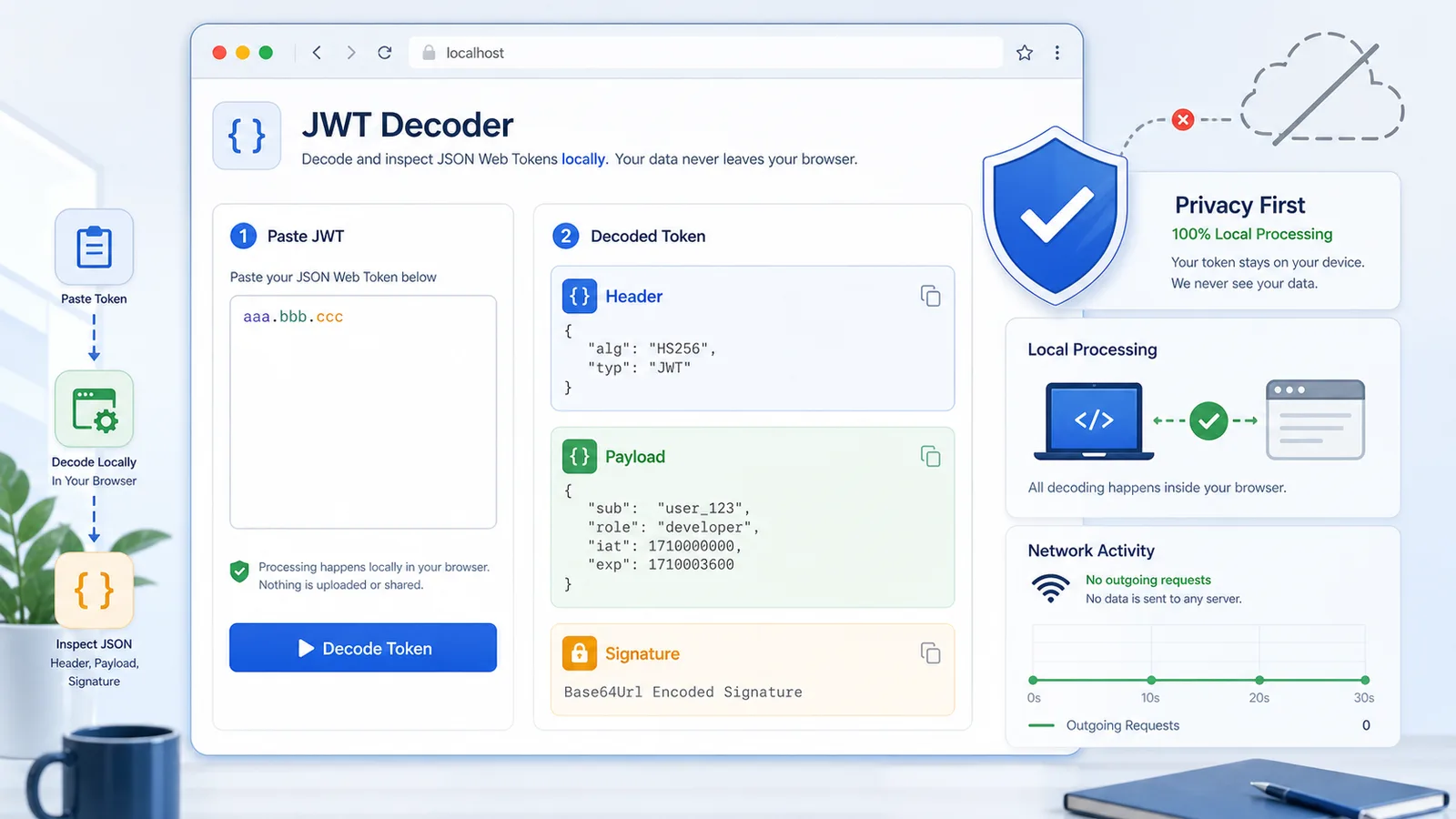
Copying production tokens into remote tools can be risky. This JWT Decoder keeps decoding local in the browser.
Use JWT Decoder as a focused local viewer for JSON Web Token structure, claims, and debugging context.
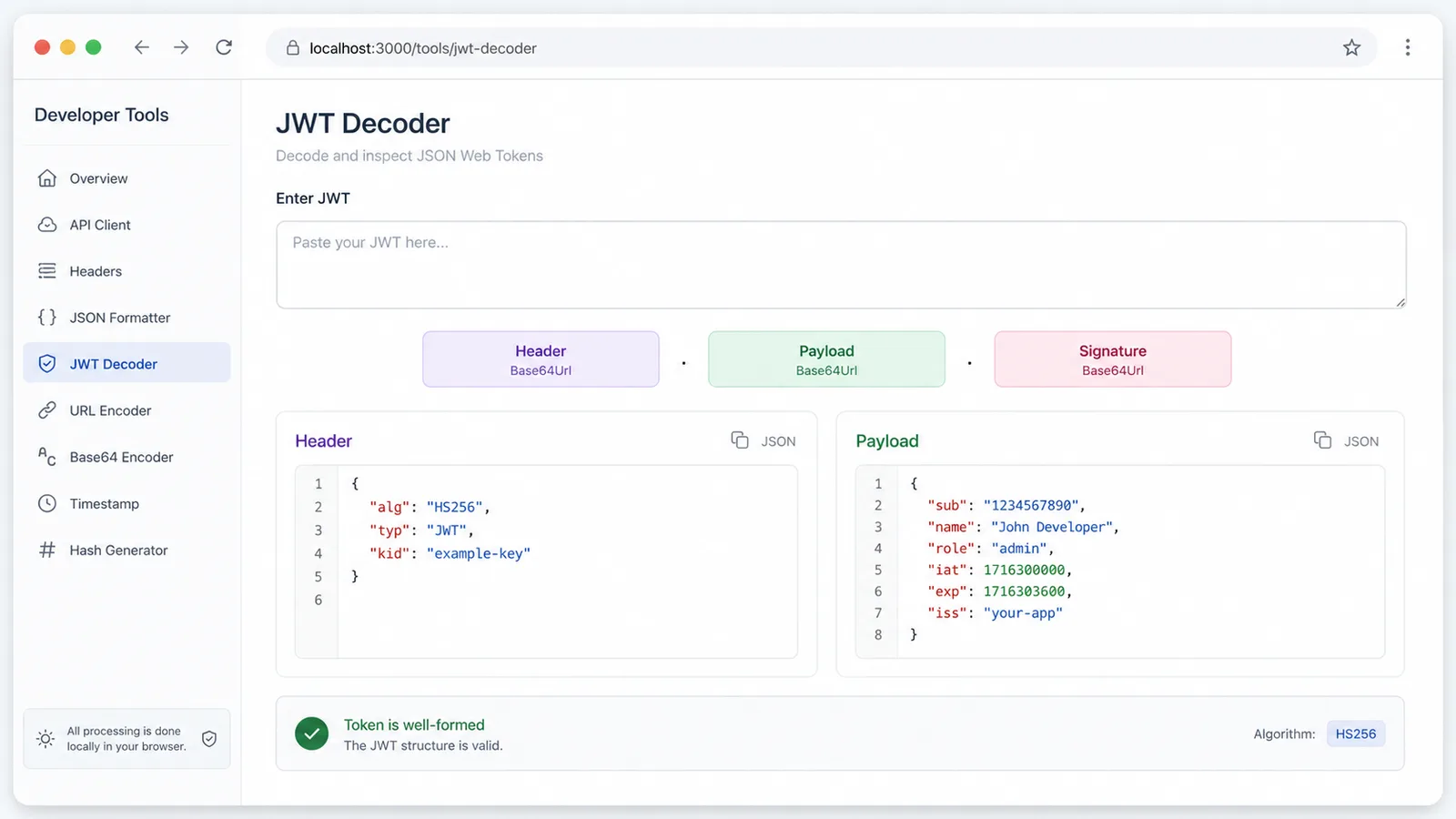
JWT Decoder separates Header, Payload, and Signature and checks whether all three compact serialization parts are present.
Header and Payload are Base64URL-decoded and pretty-printed as JSON so nested claims are easy to scan.
JWT Decoder highlights exp, iat, iss, sub, aud, alg, and typ in compact cards for fast API debugging.
The exp claim is converted to a readable date and marked as expired or not expired.
JWT Decoder runs locally after the page loads and does not send pasted tokens to a server.
The tool displays the signature segment but does not verify signatures, break encryption, or recover signing secrets.
Paste, inspect, and decide what to debug next without exposing tokens to a server.
Copy a token from an Authorization header, login response, OAuth flow, or API test and paste it into JWT Decoder.
Check whether the token has Header, Payload, and Signature, then read the formatted JSON panels.
Use exp, iat, iss, sub, aud, alg, and typ to understand login state, issuer configuration, and API identity.
JWT Decoder supports the common debugging loop for APIs, authentication, and learning.
JWT Decoder reveals the JOSE Header and JWT Payload as formatted JSON, making alg, typ, kid, scopes, and custom claims easier to read.
JWT Decoder turns exp and iat into human-readable times and surfaces iss and sub for OAuth, SSO, and login troubleshooting.
JWT Decoder is a viewer, not a token cracking service. It performs local decoding and reminds you that trust still depends on proper signature verification.
A local JWT Decoder is useful whenever compact tokens slow down debugging or teaching.
Inspect bearer tokens copied from API clients and logs to understand scopes, audience, issuer, and expiration.
Check why a session appears expired, issued by the wrong service, or tied to an unexpected subject.
Show learners how Header, Payload, and Signature fit together without sending example tokens anywhere.
Quick answers about local decoding, signature limits, and JWT claims.
No. Decoding happens in your browser with JavaScript after the page loads.
No. It displays the signature segment but does not verify trust. Verification requires the correct secret or public key and should happen in your application or server.
No. JWT Decoder is only for local decoding and viewing. It does not provide cracking, brute force, or secret recovery features.
In JWT, exp is expiration time and iat is issued-at time. They are NumericDate values measured in seconds since 1970-01-01 UTC.
Most signed JWT payloads are encoded, not encrypted. Decoding makes claims readable, but it does not prove the token is trustworthy.
Paste a token, inspect its JSON, and debug auth flows without uploading sensitive values.
Viewer only - no signature cracking or token upload.