Encodeur Decodeur Base for keys
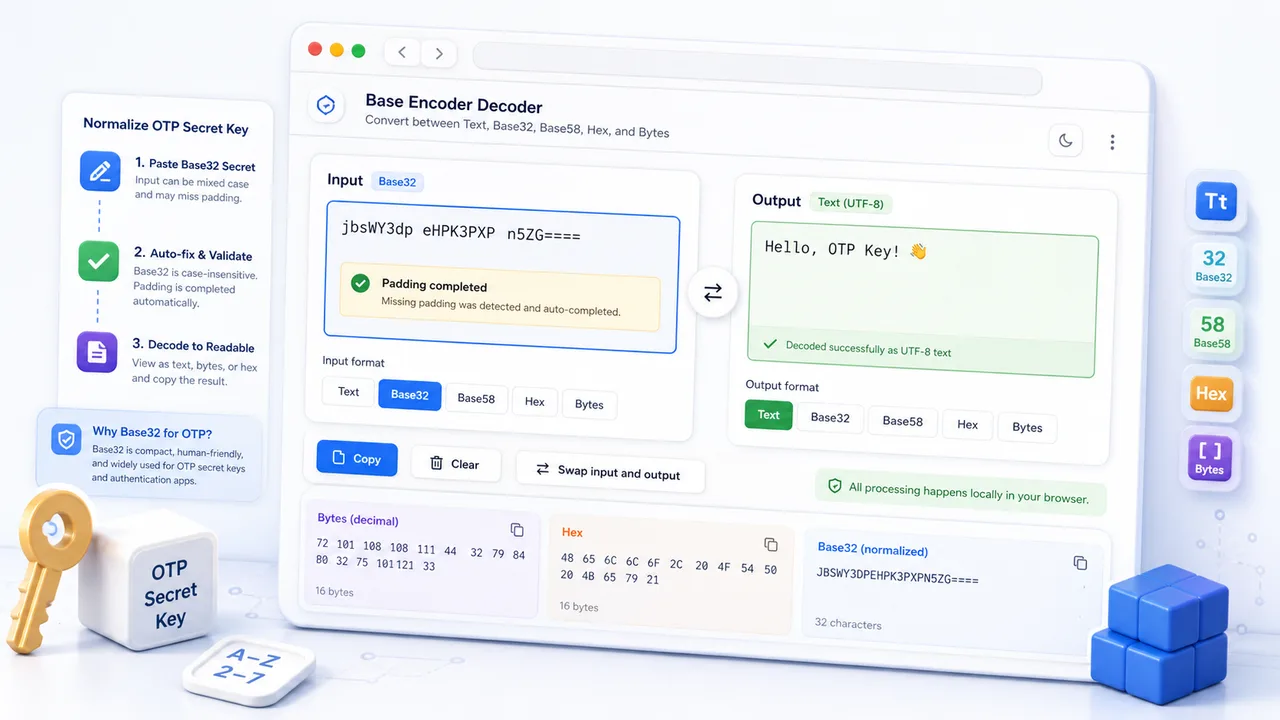
OTP secrets and setup keys often arrive as Base32 with missing padding or mixed case.
Outil developpeur gratuit
Convert plain text, Base32, Base58, hexadecimal, and byte data in either direction. The Encodeur Decodeur Base accepts lowercase Base32, repairs missing padding, and explains Base58 character errors before you copy results.
Use the Base Encoder Decoder when a token, key, address, or short ID arrives in the wrong representation.
OTP secrets and setup keys often arrive as Base32 with missing padding or mixed case.
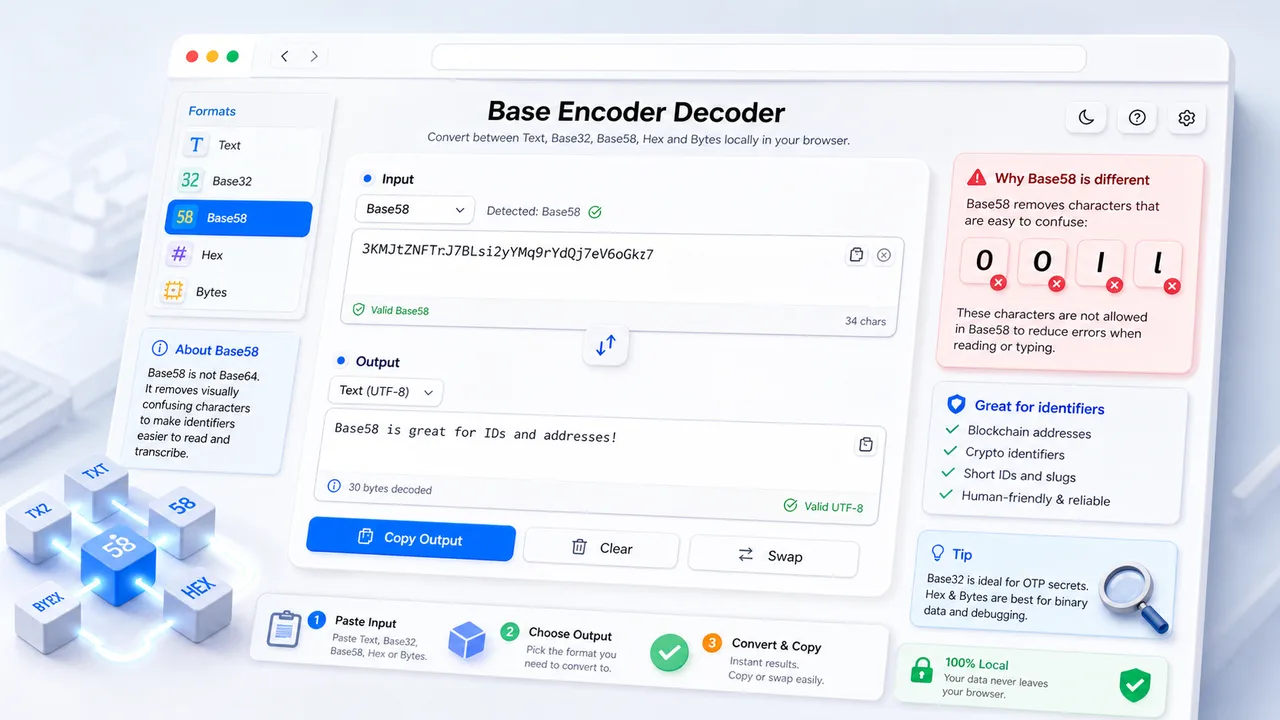
Blockchain and crypto identifiers may use Base58, which looks similar to Base64 but rejects different characters.
Debugging binary data is slower when you cannot move quickly between text, hex, bytes, Base32, and Base58.
The Base Encoder Decoder focuses on practical format conversion and clear validation.
Convert between text, Base32, Base58, hexadecimal, and byte lists.
Decode standard Base32 with lowercase tolerance and automatic padding completion.
Validate Base58 with helpful messages for omitted confusing characters.
Copy, clear, and swap input and output without uploading data.
Use UTF-8 for text while keeping hex and byte outputs available for binary data.
Work locally for OTP keys, addresses, encrypted identifiers, short IDs, and debug samples.
Three steps are enough for most Base Encoder Decoder workflows.
Choose the input format that matches your pasted value: Text, Base32, Base58, Hex, or Bytes.
Choose the output format you need. The Base Encoder Decoder converts immediately and reports invalid characters.
Copy the result, clear the panel, or swap the output back into the input for another conversion.
The Base Encoder Decoder covers authentication, blockchain, and debugging jobs in one browser tool.
OTP secrets and setup keys often arrive as Base32 with missing padding or mixed case.
Blockchain and crypto identifiers may use Base58, which looks similar to Base64 but rejects different characters.
Debugging binary data is slower when you cannot move quickly between text, hex, bytes, Base32, and Base58.
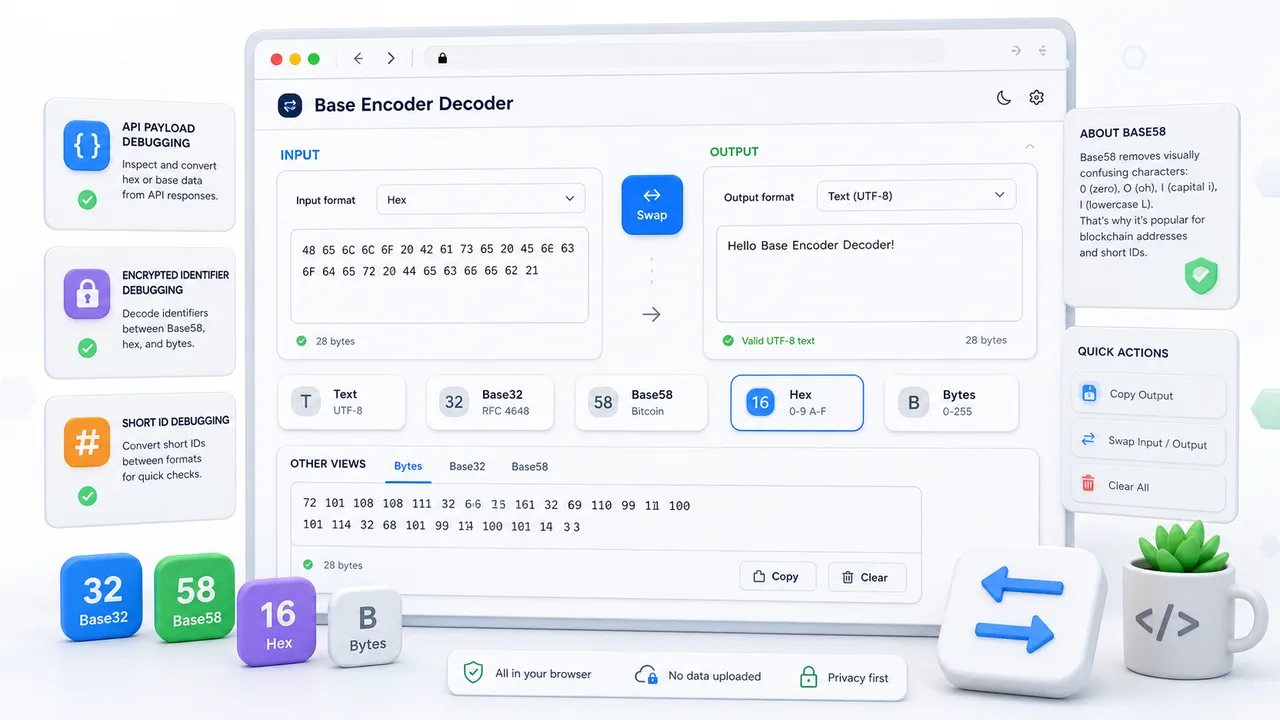
These are common places where the Base Encoder Decoder saves time.
Encodeur Decodeur Base helps with OTP secret checks by converting between text, Base32, Base58, hex, and bytes locally.
Encodeur Decodeur Base helps with Blockchain address inspection by converting between text, Base32, Base58, hex, and bytes locally.
Encodeur Decodeur Base helps with Encrypted identifier debugging by converting between text, Base32, Base58, hex, and bytes locally.
Encodeur Decodeur Base helps with Short ID conversion by converting between text, Base32, Base58, hex, and bytes locally.
Encodeur Decodeur Base helps with API payload troubleshooting by converting between text, Base32, Base58, hex, and bytes locally.
Encodeur Decodeur Base helps with Local developer experiments by converting between text, Base32, Base58, hex, and bytes locally.
Answers about Base32, Base58, padding, privacy, and binary output.
A Base Encoder Decoder converts data between representations such as plain text, Base32, Base58, hex, and bytes. This page runs the conversion in your browser.
Yes. It uses the RFC 4648 Base32 alphabet A-Z and 2-7, accepts lowercase input, and auto-completes missing padding when possible.
Base58 uses a smaller alphabet and removes confusing characters such as 0, O, I, and l. Base64 uses a 64-character alphabet and commonly includes +, /, and = padding.
Yes. The Base Encoder Decoder is useful for OTP secret keys, Base58 blockchain-style identifiers, crypto IDs, short IDs, and development debugging.
No. The Base Encoder Decoder performs conversion locally in the browser after the page loads.
Paste a key, address, encoded string, or byte list and convert it locally in seconds.
Free, browser-only, and built for quick debugging.