Batch pasted text
Paste a sentence, lesson note, name list, or OCR output and extract unique Han characters automatically.
Chinese Learning Tool
Inspect one Han character or a pasted Chinese paragraph without uploading text. Built for learners, teachers, calligraphers, OCR reviewers, and naming research.
Local dictionary with 100,000+ Han characters and 88,000+ IDS decompositions
Stop checking radical, stroke count, Unicode, and structure in separate references.
Paste a sentence, lesson note, name list, or OCR output and extract unique Han characters automatically.
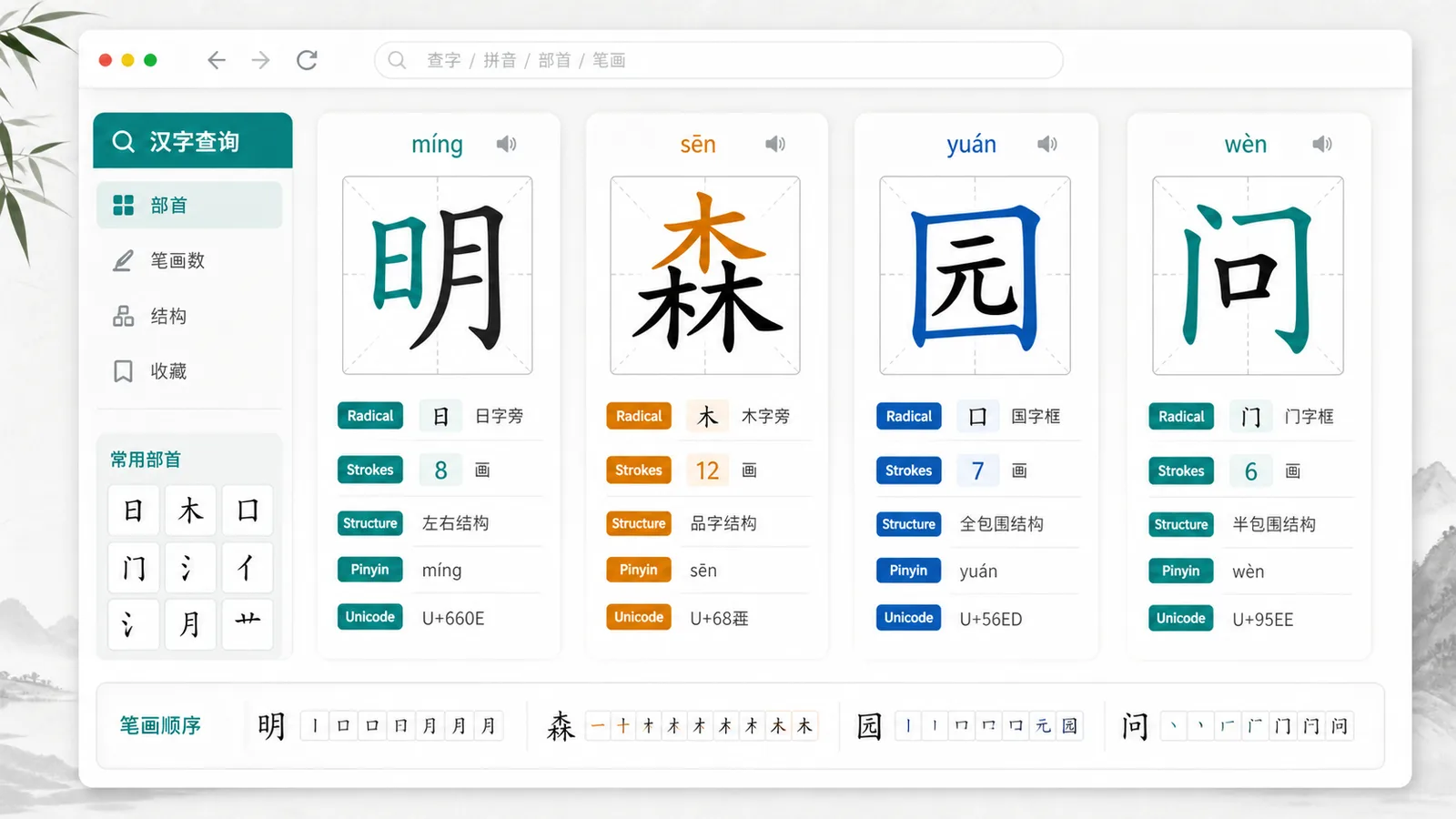
See the radical, radical strokes, remaining strokes, and total strokes together so indexing and handwriting practice stay consistent.
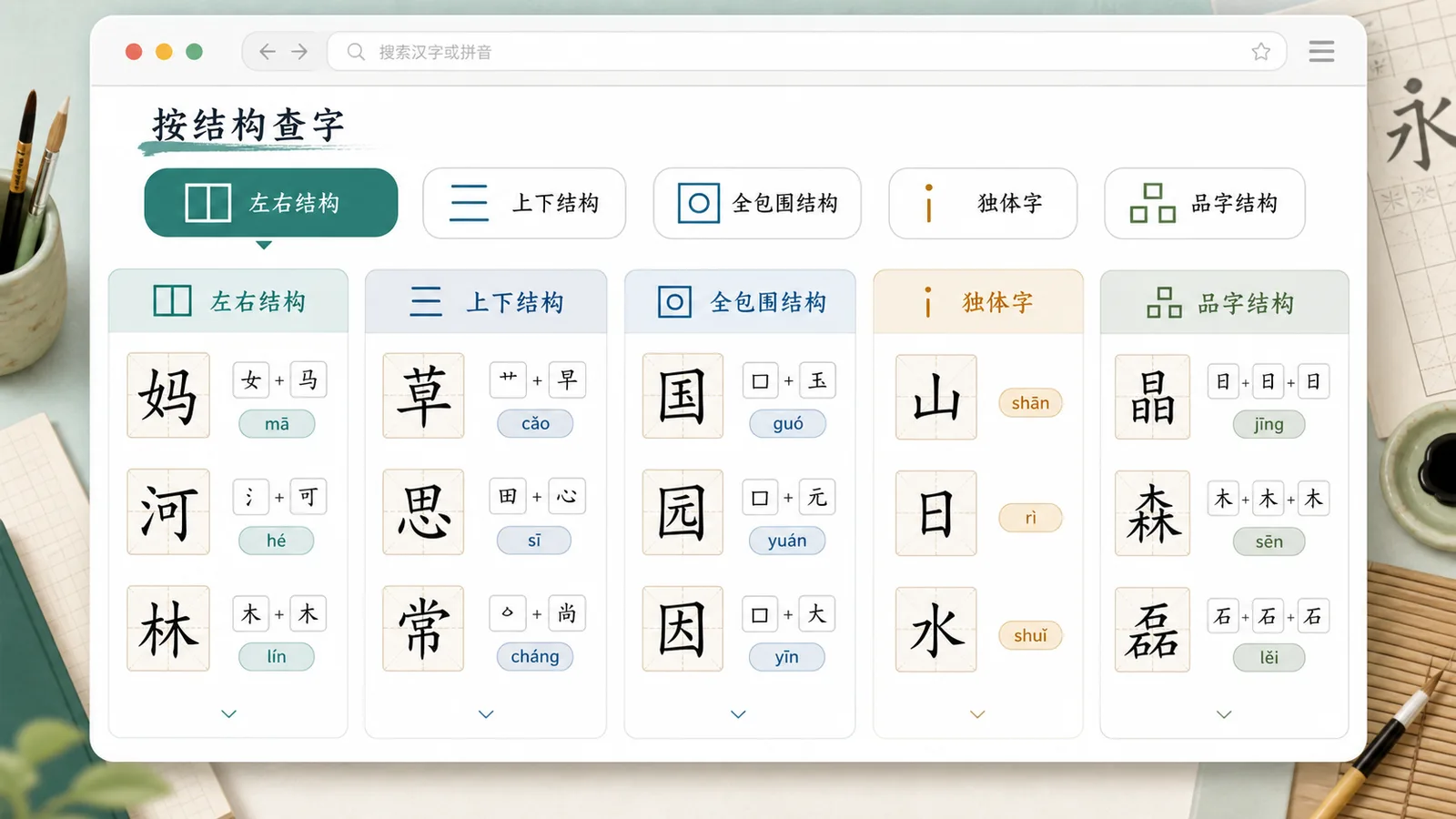
Identify left-right, top-bottom, enclosure, single-component, and triple-stacked structures while reviewing character composition.
A large local character dataset powers copy, CSV, reverse lookup, and filtering controls.
Query one character or paste a full paragraph; duplicates are collapsed so lesson lists stay readable.
The local dataset includes more than 100,000 Han characters and over 88,000 IDS decomposition entries.
Copy result rows or download CSV for worksheets, dictionary notes, naming research, and OCR review logs.
Start with character lookup, then use radical and structure modes for reverse discovery.
Use the character mode to extract Han characters from any mixed Chinese text.
Open toolCheck radical, total strokes, radical strokes, remaining strokes, pinyin, Unicode, definition, and IDS decomposition.
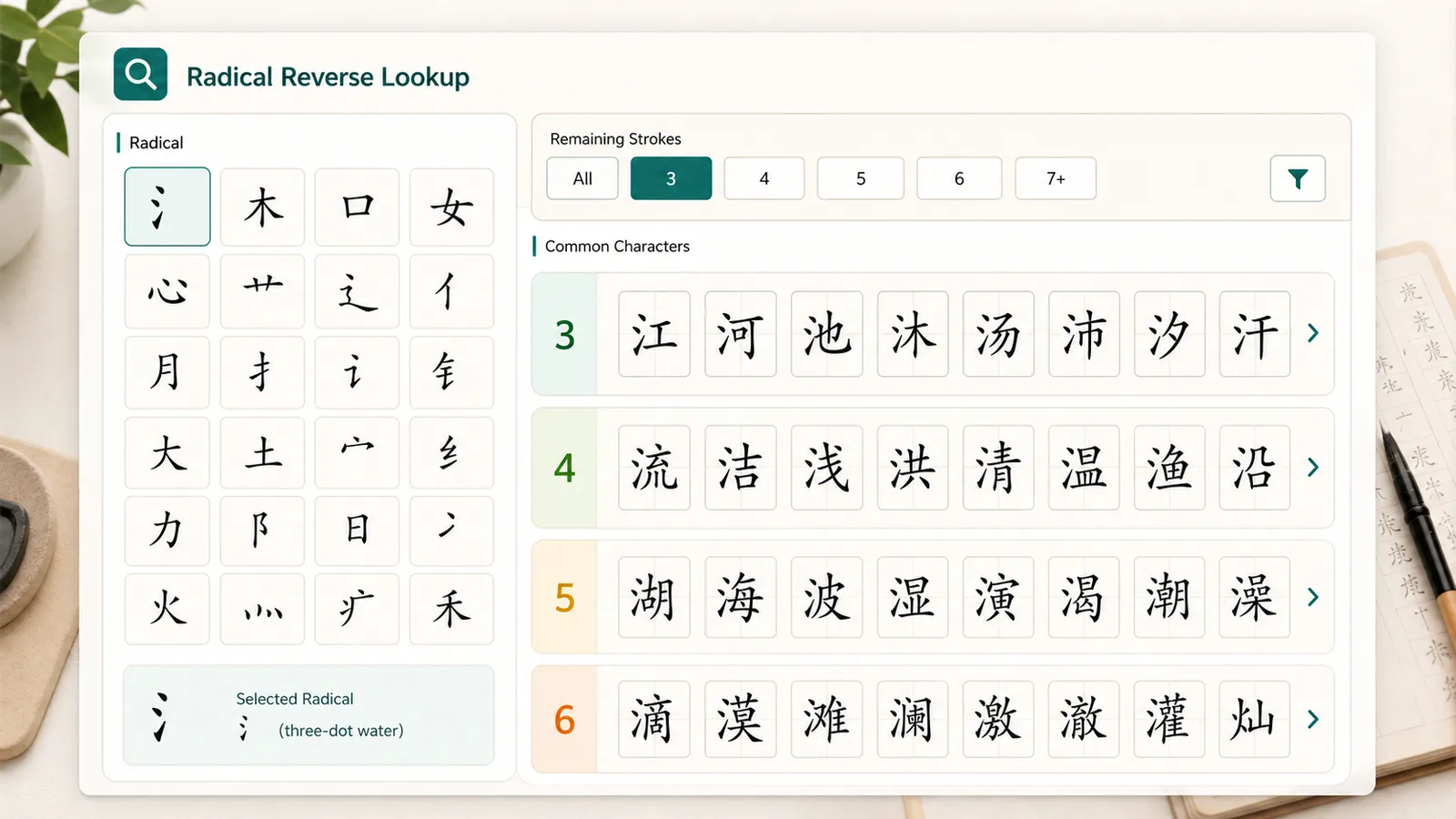
Choose a Kangxi radical or a structure type to browse matching characters and narrow the list by stroke count.
Copy the current table or download CSV for teaching slides, calligraphy notes, naming sheets, or QA records.
Use direct lookup, radical reverse lookup, and structure filtering from the same browser-side dictionary.
Paste a sentence and turn the characters into radical, stroke, pinyin, Unicode, definition, and decomposition cards.
Select a radical such as 氵, 木, 口, 女, 心, or 艹, then filter common characters by stroke range.
Explore left-right, top-bottom, semi-enclosed, fully enclosed, single-component, and 品字 structure groups.
Useful whenever Chinese character form, indexing, or decomposition needs to be checked quickly.
Prepare radical worksheets, stroke-count explanations, and character comparison activities.
Group characters by structure before practicing layout, balance, and component spacing.
Inspect suspect OCR characters by Unicode, pinyin, radical, and IDS decomposition.
Compare radicals, strokes, pinyin, and definitions for candidate characters in one exportable table.
Common questions about data coverage, radical lookup, structure labels, and CSV export.
The generated local dataset contains 102,000+ Han characters and 88,000+ decomposable IDS entries, so it covers far more than a small common-character table.
Yes. Paste mixed text and the tool extracts Han characters while ignoring punctuation, Latin letters, numbers, and emoji.
It labels left-right, top-bottom, left-middle-right, top-middle-bottom, semi-enclosed, fully enclosed, single-component, triple-stacked, and overlaid structures when IDS data is available.
No. The React tool fetches a static local JSON dictionary and runs the lookup in your browser.
Get radical, stroke, structure, pinyin, Unicode, definition, and decomposition data in a copy-ready local workflow.