These are the real bottlenecks that make engineers reach for the Instant Snowflake ID Generator every day.
Seeding a MySQL or PostgreSQL table with 50,000 mock rows that need a unique primary key is painful without a dedicated tool. The Instant Snowflake ID Generator lets you export 100,000 Snowflake IDs or UUIDs in seconds — no server, no script, no CLI.
Different distributed systems use different epochs, machine ID ranges, and bit layouts. Without a live preview, it is impossible to confirm your Snowflake ID generation config is correct. This Instant Snowflake ID Generator visualizes every bit-level parameter so you can validate the output before it ships to production.
Raw ID batches almost always need post-processing — wrapping in quotes for a SQL IN() clause, converting to a JSON array, or stripping hyphens from UUIDs. The Instant Snowflake ID Generator handles all format transformations automatically so you can paste results directly into your query or code.
Generate Snowflake IDs, UUIDs, and ULIDs in bulk. All computation happens locally — zero network requests.
Snowflake Configuration
Bit layout: 1 sign + 41 timestamp + 5 datacenter + 5 machine + 12 sequence (Twitter standard)
Format Options
Click “Generate Now” to create your IDs
Most ID generators only produce one algorithm and basic output. The Instant Snowflake ID Generator covers every format, every configuration, and every export you need.
Switch between UUID v1, UUID v4, ULID, and Snowflake with one click. The Instant Snowflake ID Generator keeps all algorithms under one roof so you never need a different tool.
Generate 1 to 100,000 IDs in milliseconds. The Instant Snowflake ID Generator uses browser-native crypto APIs and lightweight JS algorithms — no lag, no freezing, even at maximum batch size.
Set your own epoch (Twitter default, Discord, or custom timestamp), machine ID (0–31), and datacenter ID (0–31). The Instant Snowflake ID Generator performs real 64-bit bit-shift arithmetic directly in your browser.
Choose from plain list, JSON array, or SQL IN(...) format. Toggle hyphens, uppercase, or quote wrapping. The Instant Snowflake ID Generator gives you production-ready output without any manual editing.
Copy all results to the clipboard or download as .txt or .csv using the browser Blob API. The Instant Snowflake ID Generator streams files locally — no server upload, instant download.
The Instant Snowflake ID Generator runs entirely in your browser. No network request is made during generation. Your test keys, machine IDs, and datacenter configs never leave your device.
Three steps to generate, configure, and export your IDs with the Instant Snowflake ID Generator.
Select UUID v1, UUID v4, ULID, or Snowflake from the tab bar at the top of the Instant Snowflake ID Generator. Each algorithm has its own use case: Snowflake is ideal for distributed systems, ULID for lexicographically sortable IDs, UUID v4 for maximum randomness, and UUID v1 for time-ordered identifiers.
Enter the quantity you need (1 to 100,000) and choose your output format. For Snowflake, expand the configuration panel to set a custom epoch, machine ID, and datacenter ID. The Instant Snowflake ID Generator previews the first 1,000 results in real time so you can verify the output immediately.
Click 'Copy All' to send all generated IDs to your clipboard, or use 'Download .txt' / 'Download .csv' to save the full batch as a file. All export operations in the Instant Snowflake ID Generator use the browser Blob API — the data is written to disk locally with zero server involvement.
A closer look at the three core capabilities that make the Instant Snowflake ID Generator the go-to tool for developers and QA engineers.
The Instant Snowflake ID Generator uses browser-native crypto.getRandomValues() for UUID and ULID generation and BigInt bit-shift arithmetic for Snowflake IDs. A batch of 100,000 IDs is generated client-side, avoiding any round-trip latency. Results are held in memory and the first 1,000 are rendered live — the full set downloads as a file.

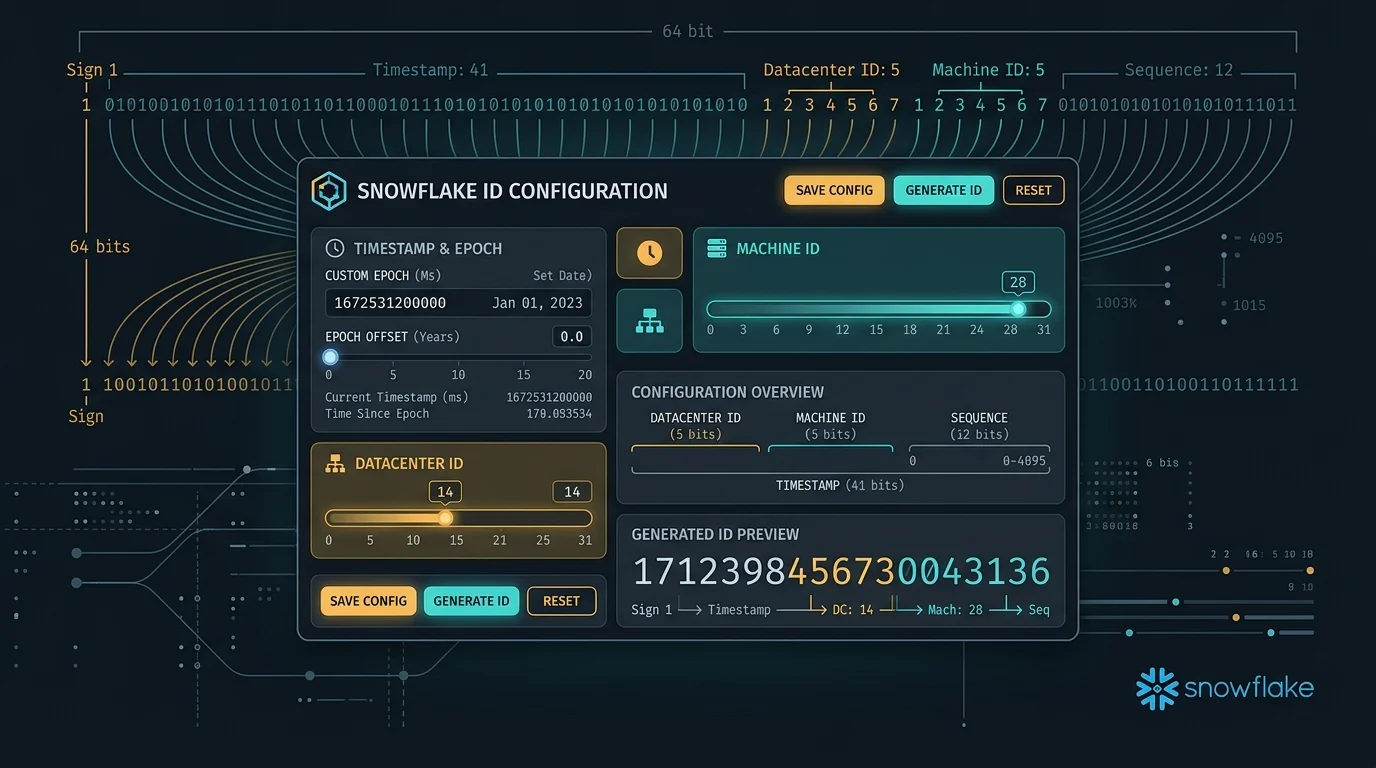
The Snowflake algorithm allocates 41 bits for the millisecond timestamp, 5 bits for datacenter ID, 5 bits for machine ID, and 12 bits for the sequence counter. The Instant Snowflake ID Generator exposes every parameter with an intuitive control panel — choose from preset epochs (Twitter 2010, Discord 2015, or a custom UTC date) and set machine and datacenter IDs from 0 to 31.
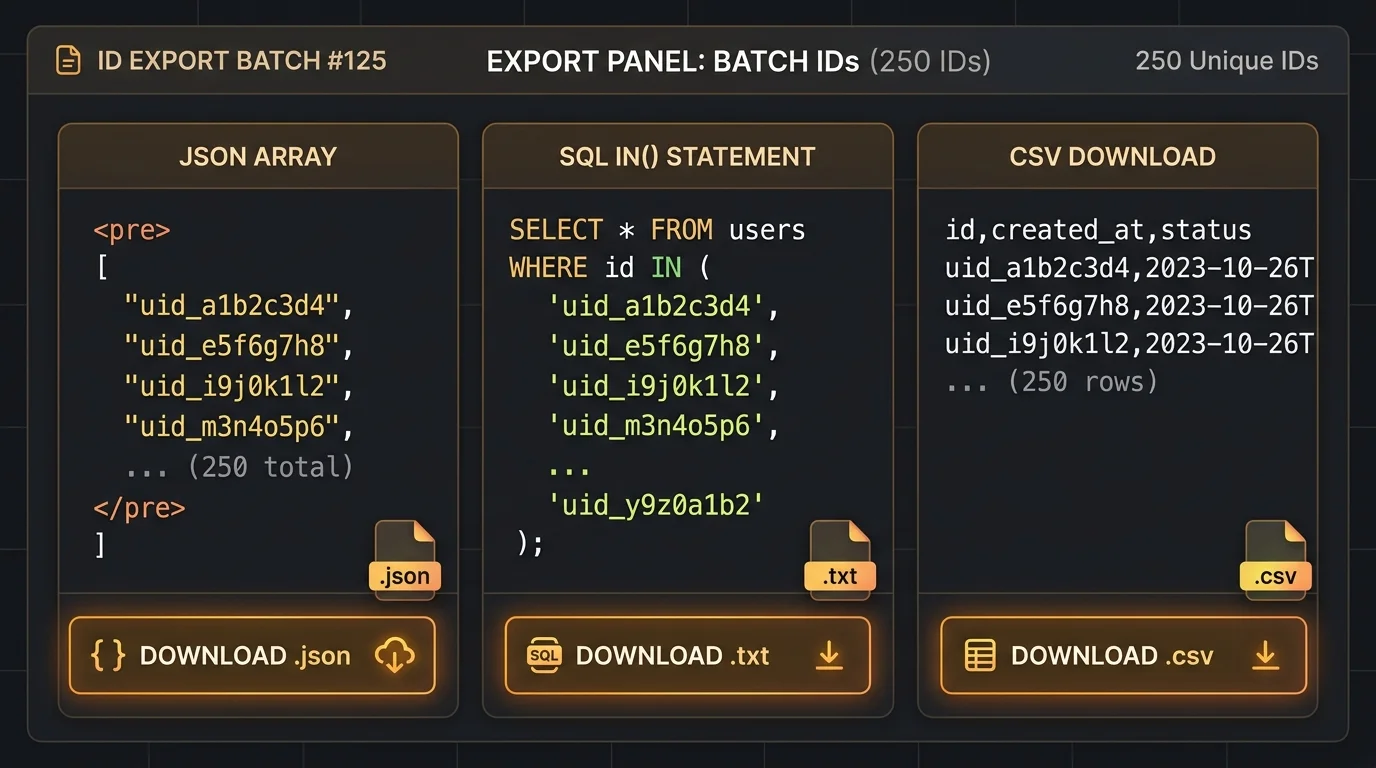
Raw ID lists require reformatting before they can be used in code or queries. The Instant Snowflake ID Generator applies your chosen format — JSON array, SQL IN() clause, or plain newline-delimited list — across all generated IDs before display or export. Toggle hyphens, uppercase, and quote wrapping with a single click.
A quick reference for developers integrating unique ID generation into distributed systems.
The Snowflake algorithm, originally created by Twitter in 2010, generates 64-bit IDs that embed the wall-clock time, a datacenter coordinate, a worker coordinate, and a per-tick sequence number. Because the timestamp occupies the most significant bits, Snowflake IDs are naturally time-sorted without any secondary index.
ULID uses Crockford's Base32 to produce 26-character strings that are both URL-safe and lexicographically sortable by creation time. Unlike UUID v4, ULID IDs expose their generation timestamp in the first 10 characters — useful for debugging and log correlation without an extra created_at field.
UUID v1 encodes a 60-bit timestamp in the identifier, making it partially traceable and time-ordered but potentially leaking the generator's MAC address. UUID v4 uses 122 bits of cryptographic randomness with no structure, offering maximum collision resistance and no information leakage.
Common questions about Snowflake IDs, UUID vs ULID, and how the Instant Snowflake ID Generator works.
A Snowflake ID is a 64-bit integer unique identifier used in distributed systems. It encodes a millisecond-precision timestamp, a datacenter ID, a machine ID, and a per-millisecond sequence counter into a single integer. Twitter originally designed the Snowflake algorithm in 2010 to generate unique IDs at scale across thousands of servers without coordination.
The Instant Snowflake ID Generator performs 64-bit BigInt bit-shift arithmetic directly in your browser. It shifts the millisecond timestamp (relative to your chosen epoch) into bits 63–22, the datacenter ID into bits 21–17, the machine ID into bits 16–12, and the sequence counter into bits 11–0. No server is involved — all computation is local.
The default in the Instant Snowflake ID Generator is the Twitter epoch (1288834974657 ms, 2010-11-04 UTC), which is the most widely documented. If your system uses the Discord epoch (1420070400000 ms, 2015-01-01 UTC) or a custom internal epoch, you can enter it directly in the configuration panel. Use the same epoch as your backend to ensure ID ranges match.
UUID v1 is time-based: it encodes the current timestamp and a node identifier, making v1 UUIDs partially sortable by creation time. UUID v4 is fully random: 122 bits are generated from a cryptographically secure random source. UUID v4 is more widely used because it has no information leakage, while v1 is preferred when insertion order matters.
ULID (Universally Unique Lexicographically Sortable Identifier) combines a 48-bit millisecond timestamp prefix with 80 bits of randomness, all encoded in Crockford's Base32. Because the timestamp comes first, ULIDs sort correctly as strings without any extra ordering column — unlike UUID v4. Use ULID when your database or log system benefits from lexicographic ordering.
The Instant Snowflake ID Generator supports batch sizes from 1 to 100,000 IDs per generation cycle. All IDs are generated and held in browser memory. The first 1,000 are displayed in the output panel, and the full set can be downloaded as a .txt or .csv file.
No. The Instant Snowflake ID Generator runs entirely in your browser. All ID generation, format transformation, and file export happens locally. No network request is made during or after generation. Your epoch settings, machine IDs, and generated output never leave your device.
Yes. Generate the quantity you need, select the SQL IN(...) or plain list format, and download as .csv. You can then import the CSV directly into MySQL, PostgreSQL, or any tool that supports bulk data seeding. The Instant Snowflake ID Generator is designed specifically for this workflow.
100% Free · No Signup · All Processing in Your Browser